

Olaniyi Evans
For three years, the naira-to-dollar rate has directly affected the cost of bread, fuel, production, and business investment decisions in Nigeria. In July 2026, the currency is more stable than it has been in several years, and reserves are at their highest level in nearly two decades. However, past volatility shows that stability in Nigeria can change quickly. Business leaders need to understand how the exchange rate affects costs, and what measures reduce exposure to currency shocks.
Reserves have recovered, but the composition carries risk
Nigeria’s gross external reserves reached about $51.74 billion as of July 10, 2026, according to Central Bank of Nigeria data reported by the press. Reserves hit a 17-year high of $51.04 billion on June 18, 2026, meeting the CBN’s full-year target and standing about 35 percent higher than a year earlier.
Reserves matter because the central bank uses them to defend the currency and pay for imports. Higher reserves reduce the risk of a sudden devaluation. However, the source of these inflows requires attention. Nigeria attracted $10.37 billion in foreign capital in the first quarter of 2026. Portfolio investment made up $9.86 billion of this, or 95.09 percent, according to the National Bureau of Statistics, while foreign direct investment was only $135.08 million, or 1.30 percent. Fitch Ratings projects reserves will decline to about $47 billion by the end of 2026, citing higher government spending and external pressures. Rising reserves are a positive indicator, but they are not a guarantee of continued stability, particularly when a large share of the inflow is short-term portfolio capital that can exit quickly.
How a weaker naira raises prices
When the naira weakens, imported goods cost more in naira terms. Nigeria imports machinery, wheat, industrial inputs, and, until recently, most of its refined fuel. As import costs rise, businesses raise prices, a process economists call imported inflation.
Headline inflation eased to 15.91 percent in June 2026, down slightly from 15.93 percent in May, according to the National Bureau of Statistics. This was the first decline in three months, following increases from 15.06 percent in February through May, driven largely by the Middle East conflict, which raised global energy prices. Food inflation rose month-on-month to 3.75 percent in June even as the annual rate eased. Inflation in June 2026 remains far below the 25.29 percent recorded in June 2025, but the recent increase shows how quickly external shocks affect domestic prices.
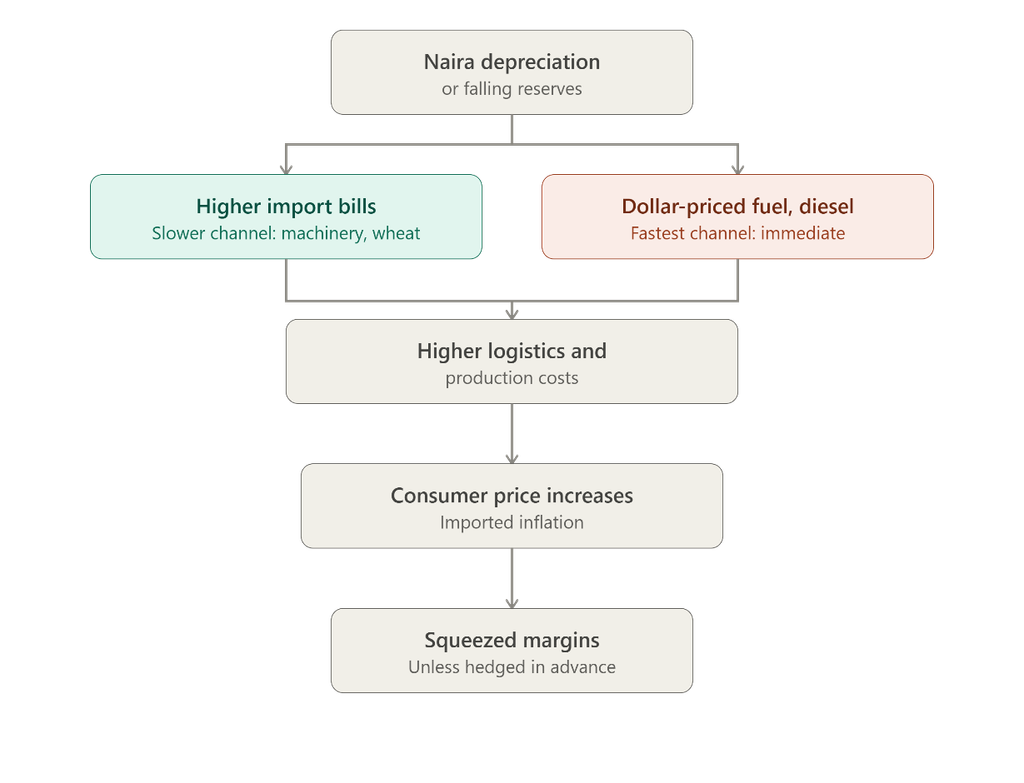
Diagram 1: FX transmission mechanism. This diagram traces two channels from currency depreciation to business margins: a faster channel through fuel and diesel, and a slower channel through imported machinery and inputs, both converging into higher production costs and consumer prices.
Fuel: the fastest transmission channel
Fuel prices respond to exchange rate changes faster than other costs. The Dangote refinery reduced its ex-gantry petrol price several times in the first half of 2026, reaching N1,075 per litre by early July. On July 13, 2026, the refinery began pricing petrol, diesel, and aviation fuel in dollars, setting petrol at $0.779 per litre, citing a mismatch between dollar-denominated crude purchases and naira-denominated sales.
This means pump prices now move directly with the exchange rate. Retail prices in mid-2026 ranged from about N1,100 to N1,400 per litre depending on location. Diesel costs rose sharply during the Middle East conflict. For businesses that depend on transport, logistics, or generator-based power, fuel is now the most direct route from a currency change to a higher cost base.
The exchange rate in mid-2026
The official NFEM rate stood at about N1,382 to N1,384 per dollar in mid-July 2026, while the parallel market traded near N1,410 to N1,425. The gap between the two rates, once above 60 percent, has narrowed to roughly N30 to N36. The naira appreciated about 3.36 percent in the first half of 2026, ranking as Africa’s second-best-performing currency, and gained 7.4 percent across 2025. The IMF’s June 2026 Article IV report estimates a real effective exchange rate gap of 25.6 percent, implying a fair value nearer N1,142 per dollar at the end of 2025.
A manufacturer holding six months of inventory faces planning difficulty when the official rate and parallel rate move independently, and when fuel costs are now set in dollars. This makes budgeting a matter of managing a range of outcomes rather than a single fixed cost.
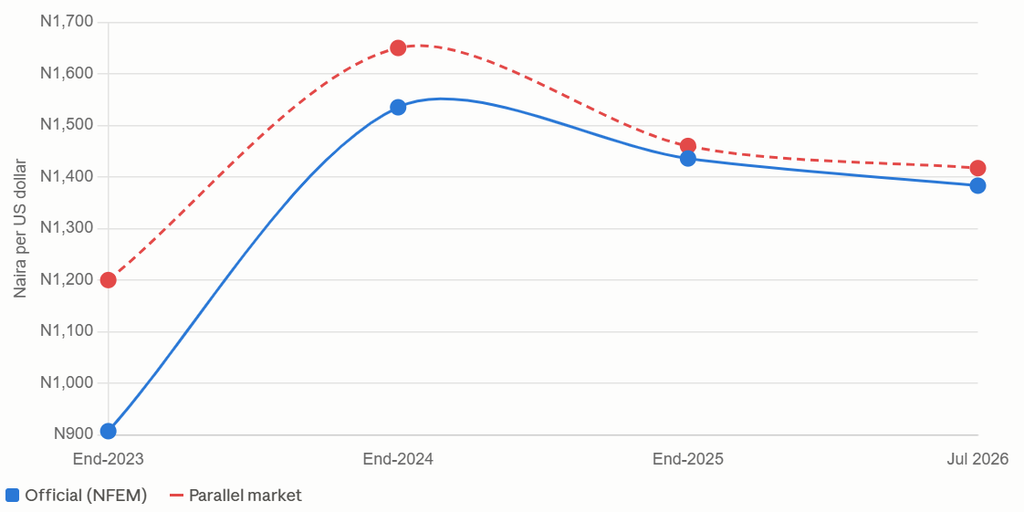
Diagram 2: Official vs. parallel market rate divergence. This line chart plots the narrowing of the gap between the official and parallel rates from 2023 to July 2026, illustrating the scale of convergence. This convergence, which I describe using the term depreciovergence, a currency weakening and its parallel-market gap narrowing at the same time, reflects the reform measures adopted since 2023 rather than a return to a fixed rate
Monetary policy and growth outlook
The CBN has held its benchmark Monetary Policy Rate at 26.50 percent, a level retained at the May 2026 meeting following a 50-basis-point cut from 27 percent in February 2026. The Committee meets again on July 20 to 21, 2026. The rate keeps borrowing costs high, which restrains inflation but also raises the cost of credit for business expansion.
The IMF’s July 2026 World Economic Outlook Update kept Nigeria’s growth forecast at 4.1 percent for 2026 and 4.3 percent for 2027, citing improved macroeconomic stability and favorable terms of trade as an oil exporter, while warning that rising prices for essentials could increase poverty and food insecurity. The World Bank projects 4.4 percent growth for 2026.
What corporate results show
Audited results from major Nigerian firms document the direct link between currency movement and financial performance. MTN Nigeria recorded a foreign exchange loss of N925 billion in 2024, as the naira fell from N907 to N1,535 per dollar, resulting in a loss after tax of N400.4 billion. The company cut its outstanding dollar letters of credit by 95 percent. In 2025, it reported revenue of N5.20 trillion and profit after tax of N1.1 trillion, aided by a net foreign exchange gain of N90.27 billion.
Nestlé Nigeria recorded a foreign exchange loss of N290.7 billion in 2024 and a loss after tax of N164.6 billion. In 2025, its currency translation loss fell to near zero, and it recorded a profit of about N105 billion on revenue that rose 26 percent, aided by increased local sourcing of sorghum, cassava, soya beans, and spices.
Dangote Cement’s net foreign exchange loss of N249.3 billion in 2024 became a net gain of N27.8 billion in 2025. Profit after tax reportedly doubled to N1,014.9 billion, while borrowings were reduced from N2.63 trillion to N1.16 trillion. Nigerian Breweries used a 2024 rights issue to repay foreign-currency debt, cutting net finance charges by 83 percent and returning to a profit of N99.1 billion in 2025 from a N145 billion loss in 2024. Unilever Nigeria increased local sourcing of raw materials to over 60 percent, up from under 30 percent previously, and reported a 43.6 percent rise in revenue and more than doubled profit after tax in 2025.
The underlying structural issue: An estimated 70 percent of manufacturing inputs are sourced from abroad, according to the Raw Materials Research and Development Council, and the Manufacturers Association of Nigeria estimates average sector FX exposure at about 40 percent. In 2025, manufacturers held nearly N1.5 trillion in raw-material inventory, partly as a buffer against currency swings, despite weaker demand. Import dependence remains the underlying reason exchange rate changes continue to pass directly into costs.
Conclusion
Nigeria’s foreign-exchange environment in mid-2026 is significantly more stable than during the currency shocks of 2023–2025, but businesses should not mistake current stability for permanent security. Higher reserves, a narrower gap between official and parallel market rates, and easing inflation have reduced immediate pressures, yet the economy remains heavily dependent on imported inputs and short-term capital inflows. The experience of firms such as MTN, Nestlé, Dangote Cement, Nigerian Breweries, and Unilever shows that companies that reduced dollar-denominated liabilities, increased local sourcing, and strengthened their balance sheets were better able to manage currency volatility and restore profitability. For Nigerian businesses, therefore, exchange-rate risk is not merely a financial concern but a strategic factor influencing costs, pricing, investment, and competitiveness. Until domestic production deepens and long-term productive investment replaces reliance on volatile portfolio flows, movements in the naira will remain a critical driver of business costs and corporate performance.