

Professor Bongo Adi Calls for “The End of Development Economics” and a New Post-Industrial Policy Paradigm for Africa
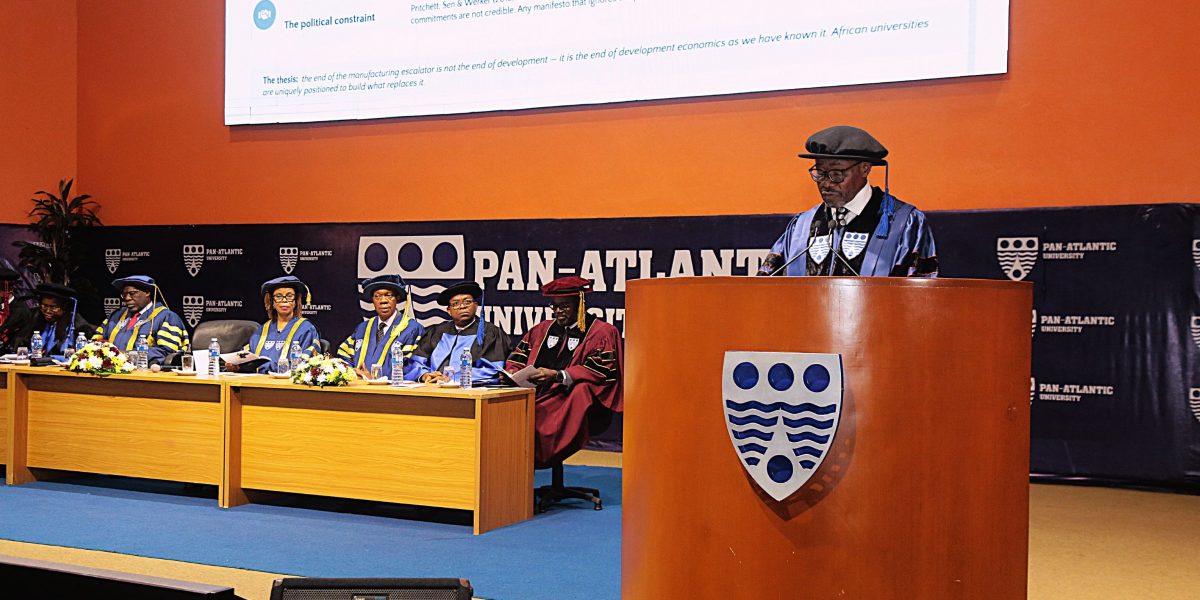
Pan-Atlantic University successfully hosted its 23rd Inaugural Lecture on Friday, July 17, 2026, featuring Professor Bongo Adi of the Lagos Business School. The high-profile academic event, held at the Honeywell Group Auditorium, Lekki Campus, drew distinguished guests, academics, policymakers, and business leaders.
In his thought-provoking lecture titled “The End of Development Economics: A Manifesto for Post-Industrial Policy,” Professor Bongo Adi challenged conventional economic thinking and called for a fundamental shift in how Africa approaches economic theory and policy in the age of artificial intelligence.
The event commenced with opening remarks by the Registrar, Mr. Kingsley Ukaoha. Professor Enase Okonedo then formally introduced the lecturer, setting the stage for a powerful and forward-looking address.
Professor Adi described the lecture topic as deliberately provocative, noting that “the end of development economics” refers both to the teleological objective of the field and to the conclusion of an era of economic theorisation. He emphasised that economic development has reached a new frontier shaped by mechanisation and artificial intelligence, which is rapidly reorganising the global division of labour. “Across Africa, a generation of entrepreneurs, engineers, and creative workers are building economic futures that no textbook predicted,” Professor Adi stated.
He critiqued the current imbalance in global economic discourse, observing that “African economists collect data, while American and European economists build theories.” Professor Adi called for African scholars to move beyond fitting local data into externally formulated theories and instead develop original frameworks grounded in African realities. “The End of Development Economics is not a cause for mourning; it is for liberation,” he declared. “For too long, African economists have been required to justify their work by reference to frameworks developed elsewhere, to benchmark their economies against trajectories established by other countries, and to apologise for how African realities deviate from Western models.”
Professor Adi urged the next generation of African scholars to replace, rather than merely refine, the old paradigm, combining clear-eyed political feasibility with fierce intellectual ambition.
Professor Enase Okonedo delivered the vote of thanks, commending Professor Adi for his bold and timely contribution to African economic thought.