



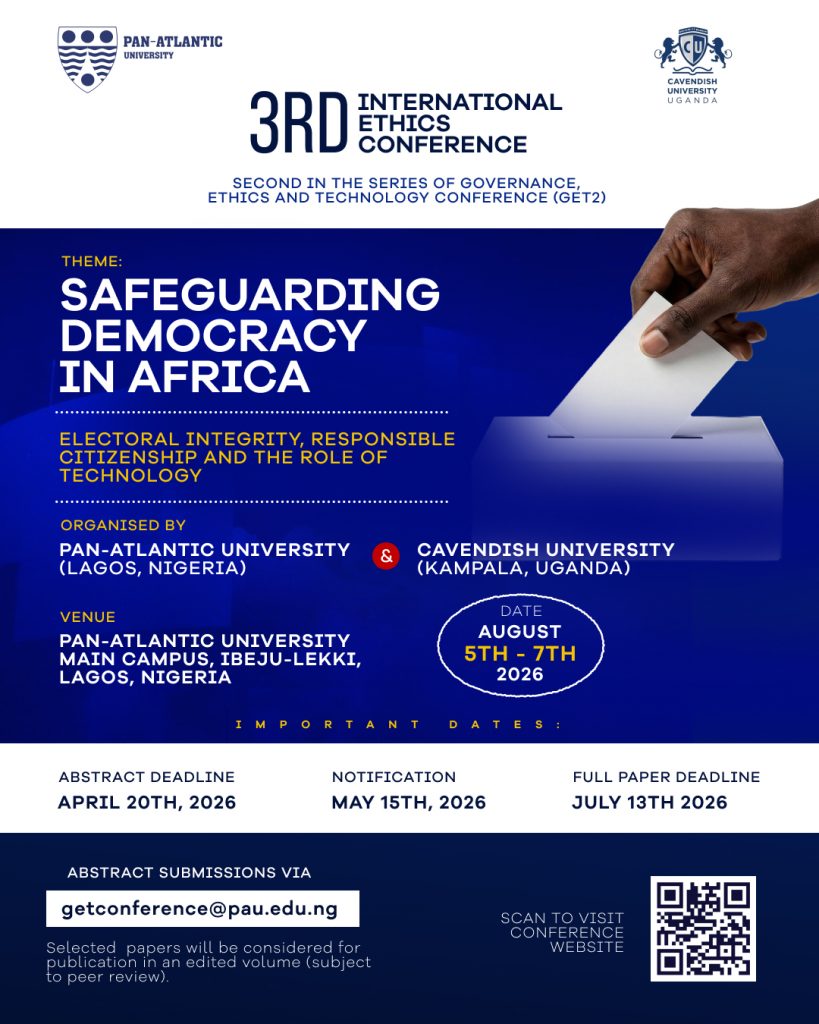
CALL FOR ABSTRACTS
2nd International Conference on Governance, Ethics and Technology (GET2)
Lagos, August 5th – 7th, 2026
Venue:
Pan-Atlantic University, Main Campus, Ibeju-Lekki, Lagos, Nigeria
Jointly Organised by:
Institute of Humanities (IOH) Pan-Atlantic University, Lagos, Nigeria
&
Cavendish University, Kampala, Uganda
Theme:
Safeguarding Democracy in Africa: Electoral Integrity, Responsible Citizenship, and the Role of Technology
Across Africa, democratic governance continues to face persistent challenges relating to electoral credibility, institutional trust, political polarisation, and the marginalisation of vulnerable groups. At the same time, digital technologies, including biometric systems, electronic results transmission, artificial intelligence, data analytics, and social media platforms, are reshaping electoral administration, political communication, and civic participation. While these innovations hold promise for enhancing transparency, efficiency, and participation, they also generate serious ethical and governance concerns, including disinformation, privacy violations, algorithmic bias, digital exclusion, and cyber vulnerabilities.
The conference is jointly convened by the Institute of Humanities, Pan-Atlantic University and Cavendish University. It brings together scholars, policymakers, practitioners, civil society actors, and technologists to engage rigorously with the ethical, institutional, and technological questions shaping electoral integrity in Africa, and to advance informed pathways for strengthening democratic governance in a rapidly evolving digital age.
1. Examine Electoral Integrity: Analyse the ethical, institutional, and technological factors that shape the credibility, transparency, and legitimacy of elections in Africa.
2. Explore the Role of Technology in Elections: Assess both the opportunities and risks associated with the use of digital technologies in electoral processes, including their implications for fairness, accountability, privacy, and inclusion.
3. Promote Responsible Citizenship: Explore the ethical responsibilities of citizens, political actors, media organisations, technology companies, and civil society in sustaining democratic norms and practices.
4. Strengthen Democratic Governance: Identify governance frameworks, policies, and regulatory approaches that can safeguard democracy while enabling responsible technological innovation.
We invite abstracts on any aspects of governance, ethics, elections, and technology, including but not limited to the sub-themes below:
Electoral Integrity and Democratic Governance
1. Ethical Foundations of Electoral Integrity
2. Electoral Laws, Institutions, and Accountability
3. Election Observation, Monitoring, and Technology
4. Political Trust, Legitimacy, and Democratic Stability
5. Electoral Violence Prevention, Management, and Democratic Stability
6. Electoral Justice and Dispute Resolution
7. Inclusion, Gender, and Political Participation of Marginalised Groups
Technology and Elections
1. Digital Technologies in Election Administration
2. Ethical Use of Biometric and Surveillance Technologies
3. Artificial Intelligence, Algorithms, and Electoral Processes
4. Data Protection, Privacy, and Cybersecurity in Elections
5. Disinformation, Social Media, and Political Communication
6. Technology, Electoral Violence, and Conflict Prevention
7. Digital Divide and Electoral Exclusion
Responsible Citizenship and Public Ethics
1. Citizenship, Civic Responsibility, and Democratic Values
2. Media Ethics, Journalism, and Elections
3. Political Campaign Ethics and Digital Advertising
4. Civil Society, Advocacy, and Democratic Accountability
5. Youth Engagement, Digital Activism, and Political Participation
6. Education for Democratic Citizenship
The conference welcomes participation from scholars, researchers, democracy advocacy groups, organised civil society groups, ethicists, policymakers, human rights advocates, and representatives from non-governmental organizations (NGOs) that engage in advocacy for democracy, ethical governance, and election reforms geared towards peaceful and fair elections.
Abstracts must be between 250 and 300 words. Each abstract should clearly indicate:
- The central research question or problem addressed
- The theoretical or conceptual framework (where applicable)
- The methodology (for empirical research)
- The main argument, findings, or policy implications
- 3–5 keywords that reflect the core themes or approach of the paper.
Please indicate the main topic and subtopic to which your abstract belongs. Selected papers will be scheduled for a 20-minute presentation, including the time for questions and discussions. All presentations at the conference will be in English. All submissions should thus be in English.
Abstracts must be submitted through our online submission system. It is a simple text editor; hence, the abstract should not have footnotes. Prepare your abstract in simple text, then copy and paste it into the form.
Abstracts will be peer reviewed anonymously. Therefore, the body of the abstract should not contain any information that would identify the author(s). Instead, information relating to the author’s name, contact details and institution/organisation should be provided in the relevant columns in the submission form.
Authors of accepted abstracts will be invited to submit a full paper of:
- Maximum 6,000 words, including references
- Font: Times New Roman
- Font size: 12-point
- Line spacing: 1.5
- Standard margins (1 inch / 2.54 cm)
- All papers must follow the APA 7th edition referencing style.
Selected revised papers will be considered for publication in an edited book by a reputable publisher, subject to peer review.
Also, actionable recommendations will be presented at the end of the conference to help policymakers promote democratic values, electoral integrity, and ethical and responsible citizenship in Africa.
Extended Abstract Submission Deadline: 15 May 2026
Notification of Acceptance: 25 May 2026
Deadline for Full Paper Submission: July 13, 2026
All submissions must be made through the online submission system.
Foreign Participants:
Professionals and academics: $ 250 USD
Students: $ 150 USD
This fee covers accommodation, feeding and ground transportation.
Local Participants:
Professionals: N 100, 000 only
Postgraduate Students: N 70, 000 only
Student: 50,000 only
Account Details:
Foreign participants: Dollar account
Domiciliary Account Through Citibank New York:
Intermediary Bank: CITIBANK, NEW YORK
Intermediary Bank’s Swift Code: CITIUS33
Fedwire/Aba No.: 021000089
Intermediary Bank’s Account No. with Citibank New York: 36129295
Beneficiary Details to Credit:
Account No.: 0246972849
Account Name: Pan-Atlantic University
Bank: Guarantee Trust Bank (GTB)
Swift code for GTB: GTBINGLA
Local participants: Naira account
Account No.: 1000027699
Bank: Globus Bank
Account Name: Pan-Atlantic University-Institute of Humanities
Please click on the link here to register for the conference.
Obinna Ikejimba. (Pan-Atlantic University, Nigeria)
Email: oikejimba@pau.edu.ng
Dr Busuoluwa Huthaifah (Cavendish University, Uganda)
Email: hbusuulwa@cavendish.ac.ug