

Ekundayo Peter Mesagan (Professor of Energy & Environmental Economics, PAU)
Executive Summary
Nigeria, Africa’s largest oil producer, stands at a critical juncture: balancing petroleum pricing with environmental sustainability. The removal of fuel subsidies in 2023 has reshaped the energy landscape, triggering economic, environmental, and socio-political consequences. While subsidy removal enhances fiscal sustainability and nudges households toward cleaner energy, it also raises affordability concerns, particularly for low-income families and SMEs. This insight explores the economic impact, environmental consequences, and socio-economic trade-offs of petroleum pricing before offering policy prescriptions for a balanced energy future.
Background: The Dual Challenge
Nigeria’s economy is deeply tied to petroleum as oil accounts for about 90% of foreign exchange earnings and around 60% of government revenue. Yet, reliance on fossil fuels contributes to CO₂ emissions exceeding 100 million metric tons annually. Fuel subsidies historically consumed $7–10 billion per year, crowding out investment in infrastructure, education, and healthcare. The removal of subsidies in 2023 marked a turning point. Petrol prices rose from ₦185/litre to over ₦600/litre, sparking inflationary pressures while also incentivising the adoption of renewable energy (see Pan African Review, 2026; The News, 2026; Mondaq, 2026).
Economic Impact of Petroleum Pricing
Subsidy Era (Pre-2023)
Subsidies kept fuel prices artificially low, encouraging overconsumption. Black markets thrived, with petrol often diverted across borders to Niger, Benin, and Cameroon. Long queues at filling stations wasted millions of man-hours annually.
Post-Subsidy Era (2023–Present)
Government fiscal savings are estimated at around ₦4 trillion annually. Transport costs surged by 200–300%, raising food prices and inflation, with headline inflation reaching 33% in 2024 (see IMF Country Report No. 24/102, 2024; Pan African Review, 2026). SMEs reliant on petrol generators faced higher operating costs, leading many to shut down. Figure 1 presents the evidence of fiscal savings vs inflationary impact between 2022 and 2025. Statistics in Fig. 1 show that fiscal savings rise sharply after subsidy removal, while inflation peaks mid‑transition before easing. It’s ideal for embedding in your Economic Impact section to visually emphasise the trade‑off between fiscal stability and consumer price pressure.
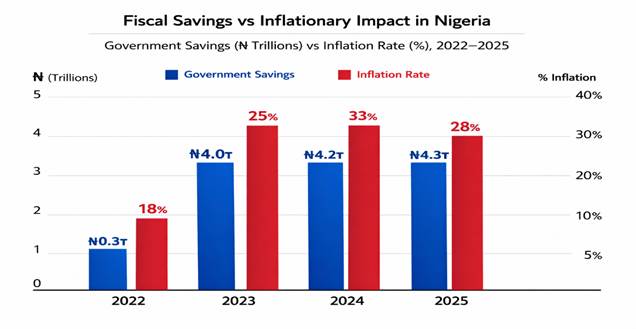
Figure 1: Nigeria’s Fiscal Savings and Inflation
Source: Author’s Sketch
Environmental Impact of Petroleum Pricing
Regarding fossil fuel dependence, low fuel prices previously encouraged high consumption of petrol and diesel.Nigeria ranked among the top 10 gas flaring nations, releasing methane and CO₂. Also, the post-subsidy shift means that high fuel costs have accelerated the adoption of alternatives as follows:
- Solar mini-grids now power over 100 rural communities.
- LNG adoption in transport fleets is rising.
- Households increasingly invest in solar inverters and panels.
Figure 2 shows the Nigerian energy transition pathway. In Fig. 2, the removal of subsidies led to higher fuel prices, thereby encouraging the shift to renewables, reducing emissions, and promoting environmental sustainability. This transition aligns with Nigeria’s Energy Transition Plan (ETP), which targets net-zero emissions by 2060.
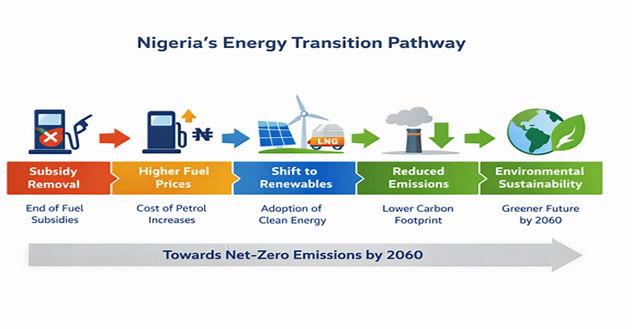
Figure 2: Nigeria’s Energy Transition Pathway
Source: Author’s Sketch
Socio-Economic Consequences
Positive Outcomes
- Fiscal sustainability: reduced government spending on subsidies.
- Increased investor confidence in Nigeria’s energy sector.
- Gradual diversification toward renewables.
Negative Outcomes
- Low-income households face energy poverty.
- SMEs struggle with higher costs and worsening unemployment.
- Rising transport costs amplify food insecurity.
For instance, a Lagos-based bakery reported that its monthly energy costs rose from ₦150,000 to ₦450,000, forcing layoffs. Transport unions increased fares by 250%, disproportionately affecting rural commuters. Figure 3 indicates some household energy expenditure (Urban vs Rural, 2022–2025). In Fig. 3, spending by urban households rose from ₦5,000 to ₦18,000/month, while spending by rural households rose from ₦3,000 to ₦12,000/month.
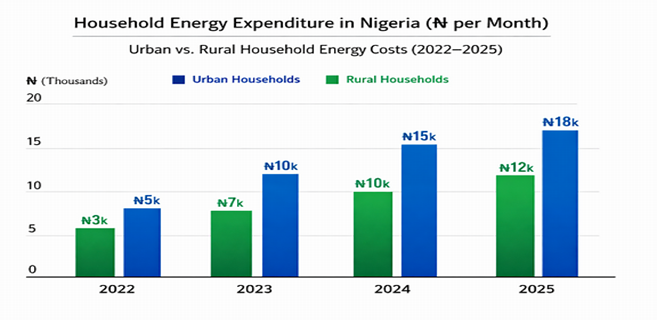
Figure 3: Household Energy Expenditure
Source: Author’s Sketch
Policy Prescriptions
1. There is a need for a balanced petroleum pricing template. Thus, regulators such as NMDPRA and NUPRC should design pricing that reflects environmental costs while ensuring affordability.
2. Targeted social safety nets are necessary to facilitate the expansion of conditional cash transfers and transport vouchers for vulnerable populations. Efficient targeting should be done using digital platforms.
3. Accelerating the energy transition is critical through the incentivising of solar, wind, and LNG investments through tax breaks and concessional financing. In addition, encouraging public-private partnerships for renewable infrastructure can also support the process.
4. There is a necessity for stakeholder engagement and awareness through continuous dialogue with unions, SMEs, and civil society to manage transition shocks. Also, through public campaigns on energy efficiency and clean alternatives.
5. Regional cooperation is essential through effective collaboration with ECOWAS to curb cross-border fuel smuggling. This would help to strengthen the harmonisation of energy policies in the sub-region to stabilise regional markets.
Conclusion
Petroleum pricing in Nigeria is more than an economic lever—it is a climate, social, and political instrument. The removal of subsidies has created both opportunities and challenges: fiscal savings and environmental gains on one side, affordability crises and social unrest on the other.
Nigeria’s path forward requires a delicate balance:
- Protecting vulnerable populations,
- Accelerating clean energy adoption,
- Ensuring fiscal sustainability, and
- Embedding environmental accountability.
If managed strategically, Nigeria can transform its petroleum pricing challenge into a catalyst for sustainable growth.