

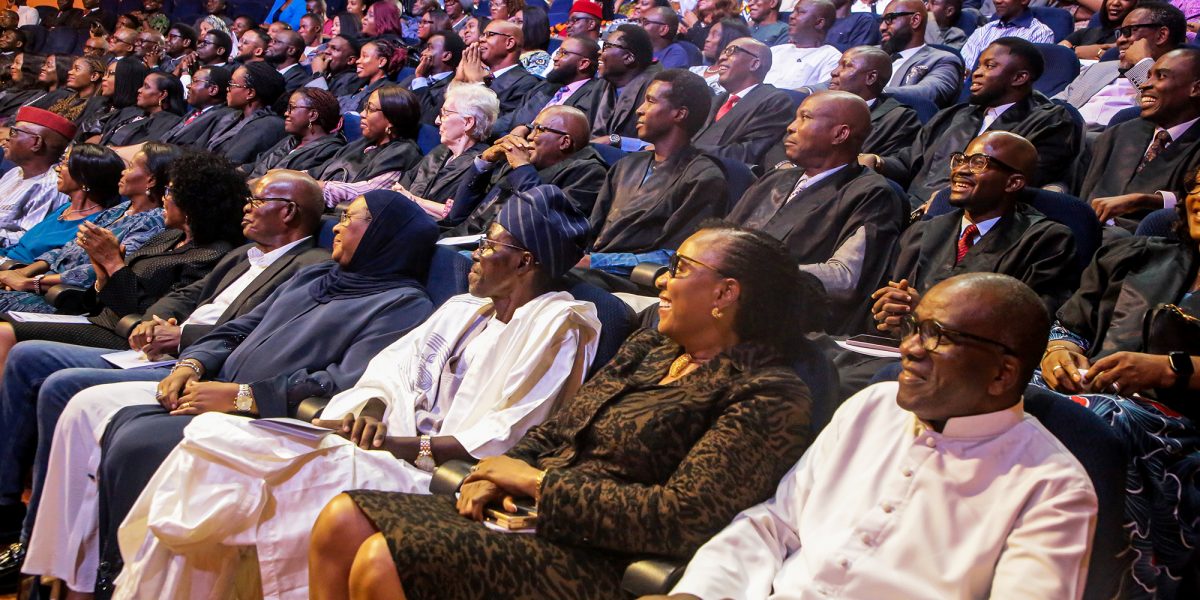
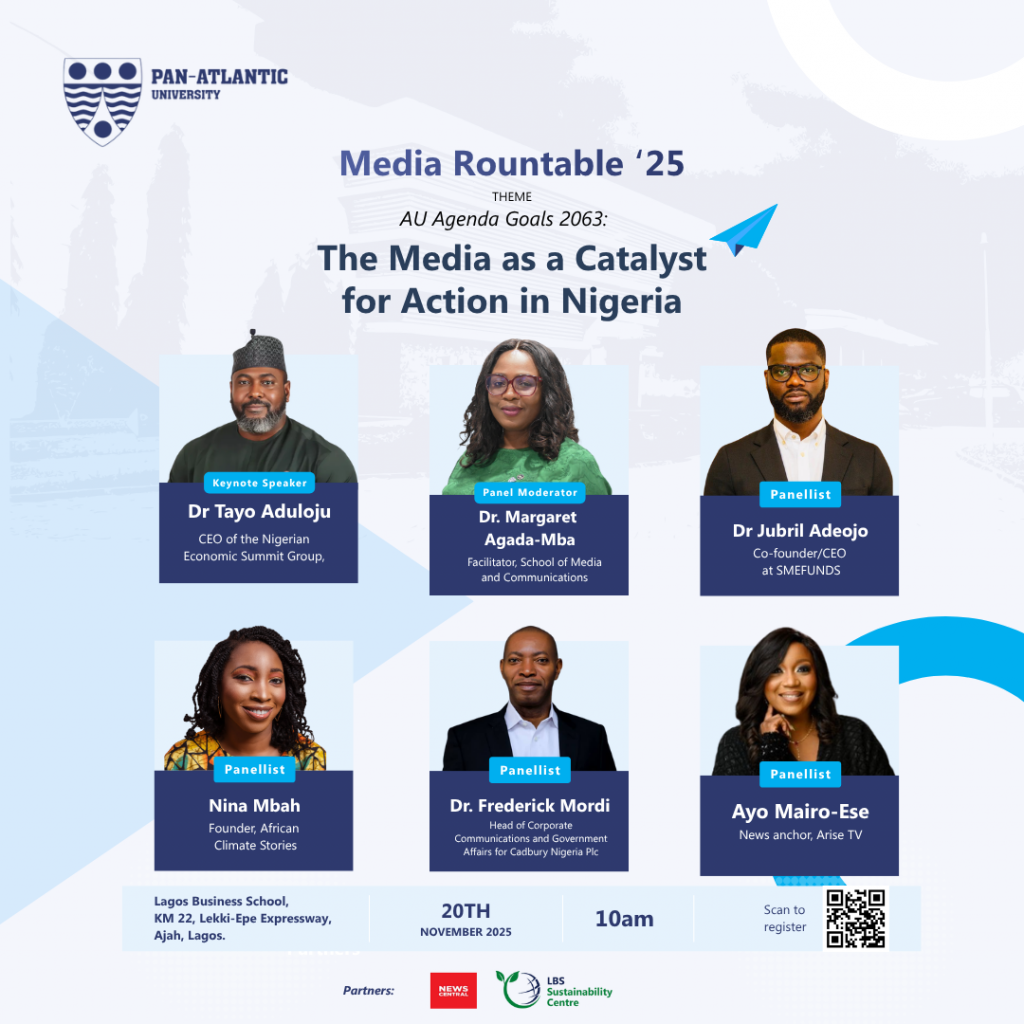
Pan-Atlantic University’s Media Roundtable has established itself as a forum for dialogue on the intersection of media, governance, and society. The first edition addressed “Navigating Media and Trust in the Digital Era,” and the second focused on “Beyond Critique: The Importance of Constructive Media Engagement in Governance and Nation Building.” This year, we are focusing deeper into Africa’s long-term development framework; Agenda 2063 exploring the pivotal role of the media in driving actionable progress towards this vision within Nigeria.
AU Agenda 2063 is the continent’s 50-year blueprint aiming for inclusive growth, sustainable socio-economic development, democratic governance, peace, cultural identity, and global influence. Nigeria, as a key player in the continent, is expected to leverage the media’s power in advancing these ambitious goals. This roundtable seeks to unpack how media practitioners can act as catalysts for informed citizen engagement, transparency, accountability, and advocacy for these objectives.
AU Agenda Goals 2063: The Media as a Catalyst for Action in Nigeria
- To deepen understanding of Agenda 2063 goals in the Nigerian context among media professionals.
- To explore practical ways the media can spur action and hold key stakeholders accountable in advancing these goals.
Expected Outcomes
- 200+ attendees engaged
- Policy brief on Media & Agenda 2063
- Live coverage + post-event report
- To facilitate multi-sector dialogue that includes government, civil society, and media stakeholders for building partnerships towards the Africa Agenda 2063.
- To inspire and equip media practitioners with tools and narratives that amplify the continent’s development agenda constructively.
- Journalists and Editors
- Content Creators and Influencers
- Government Officials
- NGOs and Development Partners
The dress code for the roundtable is smart business or traditional attire.
As the conversations and themes of this year’s roundtable touches on the Africa Union, a touch of formal traditional attire is always a welcome expression of our heritage, though entirely optional.
In line with the School’s standards of professionalism, you are advised to dress modestly and avoid revealing clothing.
Please click here to register.
We have also made transportation arrangements with Shuttlers for interested participants. Please click here to indicate your interest.
Important Information
Light breakfast and coffee will be served between 10:00 a.m. and 10:50 a.m. Breakfast closes at exactly 10:50 a.m and the roundtable sessions will begin at exactly 11:00am.
In line with Pan-Atlantic University’s commitment to discipline and professionalism. We recommend that you arrive before 10 am to complete registration and be seated before the opening session begins.
Each attendee’s conference tag includes meal tickets for both breakfast and lunch, which will be required for meal access. Please keep your tag visible and with you throughout the event.
Over 200 participants across the media and sustainability sectors will be represented at the Roundtable. Come prepared to learn from and network with industry leaders across the sector.
We look forward to hosting you at this year’s roundtable and to an engaging day of insights, connections, and forward-looking conversations.
Should you have any questions or need further assistance, please feel free to reach out at comms@pau.edu.ng
Note: We are also working with limited in-person slots, and we have had an overwhelming number of requests to attend physically. If for any reason, you will not be able to attend the roundtable in person, please let us know as soon as possible. This will help us offer your seat to others who are eager to participate.
We look forward to welcoming you to the roundtable.

Keynote Speaker
Dr. Tayo Aduloju, the CEO of the Nigerian Economic Summit Group, Nigeria’s foremost private sector led think tank and policy advocacy group, is a Policy Entrepreneur, Strategist, Economist, Scholar, Teacher and Global Development Expert, most sought after for his competencies and capabilities in translating strategic agendas into results. Before his current role, he served as COO and Senior Fellow, Economic Policy, Strategy and Competitiveness at the NESG and Okun Model Economic Fellow for Africa and the Middle East. His over two decades of experience and track record demonstrate his commitment to developing and advising leaders, organisations, and nations to stimulate performance, sustainability, governance, and impact across private, public, and non-profit sectors. He has worked across several economic, social, and political reform areas and sectors, across Nigeria, 14 other African countries and the Middle East, where he has advised business executives and heads of government (including former President Yar’adua and Obasanjo).
Tayo holds six academic degrees, including a doctorate degree in Economic Policy and Public Administration, with an impactful post-doctoral scholar-practitioner career in economic growth diagnostics and multidimensional poverty analysis, economic policy, public administration and strategic management and a formal and executive education that cuts across leading institutions like Harvard University, Oxford University, MIT and INSEAD. Tayo is a Senior Executive Fellow of John F. Kennedy School of Government, Harvard University. His versatility shows in the number of distinguished fellowships he has been awarded from various professional institutes: the Institute of Management of Consultants, the Institute of Strategic Management Nigeria (Chartered), the National Institute of Credit Administration, Chartered Institute of Administration and Chief of Staff Association. He is a member of the Chartered Institute of Directors, and Nigerian Economic Society. He is a board member of the Governing Council of the Nigerian Institute of Management (Chartered).
Panelists
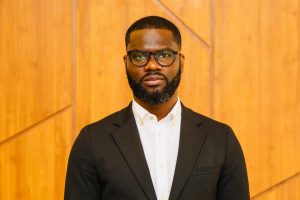
Dr. Jubril Adeojo is the Co-founder/CEO at SMEFUNDS Capital Limited. Dr. Jubril led the consortium that set up the $100million Nigeria-Green Energy Fund programme that is backed by the African Guarantee Fund; senior climate fund adviser on the $10Billion Climate Change Fund; Senior Adviser on the $5Billion AfDB Green Credit Facility. Dr Jubril purposefully aligns the Performance standard reviews with his knowledge and approach to structuring, setting up and managing climate and sustainability Funds for private sector and government across Africa.
He has over 17 years’ professional experience covering investment and commercial banking, development finance, blended finance, tech startup investing, business coaching, project finance, corporate finance, economics, strategic planning, ESG and Performance Standard reviews and audit, agriculture finance, climate & sustainable energy finance, agribusiness, enter- prise development, community development, financial inclusion and livelihoods co-creation and security, and funds raising. His professional career covers working for Nigerian commercial and investment banks, one of the big four auditing firms, and a couple of advisory services to bi-lateral and multi-lateral development agencies on climate finance and sustainability matters in alignment with the Nationally Determined Contributions (NDCs) of different African countries under the Paris Agreement for Climate Change.
Dr Jubril is a certified climate and sustainable energy finance expert from the reputable Frankfurt School of Finance and Management. He holds a PhD in development finance and community development from the Da Vinci Institute for Technology Management; MSc. in Strategic Finance and BA. in Business Administration from Oxford Brookes University and University of Hertfordshire, United Kingdom respectively.
A few pivotal projects and programs he championed are as follows:
1. Led the development of business plan for the sovereign $10Billion Nigeria Climate Change Fund
2. The issuance of the first ever corporate green sukuk in Africa, the 13th in the world, and first joint issuance of a bond and sukuk in a single issue. $25million green bond/sukuk programme in Nigeria. The setup of the $100 million Nigeria Green Energy Programme in collaboration with African Guarantee Fund (AGF), a foremost pan African credit insurance companies in Africa.
3. Led the consortium that developed the guidelines for mainstreaming climate ac4on into the line of credit for the African Development Bank (AfDB) to extend to primary financial institutions across Africa towards achieving NDC targets by 2030 and Net Zero targets by 2050. On this project, I led client engagements to establish 1,000 green businesses, analysed climate business models and sythesizing learnings, integrated corporate partners and start- up capabilities to develop new ventures, and supported building our capability by transferring knowledge and experience to our teams
4. Designed the $5 Billion Green Finance Sector Credit Facility Programme for the Bank
5. Led the team that managed the $600 million Central Bank of Nigeria concessional loan fund at the bank to finance 5,000 young entrepreneurs (both aspiring and emerging) in the country. Focused on agribusinesses, schools, ICT, co8age industries, and creative industries
6. Led Capacity building training for 200 managers and executives of regional and local development financial institutional across Africa
7. Sit on the Board of startups and finance companies, and also lead climate finance advisory for African Sovereigns.
He is a Senior fellow at the Trans4m Center for Integral Development, Switzerland; Research Associate at the University of Johannesburg, South Africa; a member of Faculty of Green Bond Course of the United Nations University – Ghana; a member of the Faculty of Green Bond Course at X-Academy of Nigeria Stock Exchange Group; a pioneer member of the Financial Centre for Sustainability, Lagos (LC4S).